Thirty years ago, a Submariner on your wrist said something about you. It said you were someone who used tools, or at least respected the idea of them. Today it says something rather different: that you were patient enough to befriend a retailer, or wealthy enough not to need to be.
Rolex has not fundamentally changed the Submariner since 1953. This is presented, by the company and its admirers alike, as a virtue. Robustness of design. Confidence. An object so correct it requires no revision. But there is another way to read seventy years of marginal evolution: as a brand so dominant it has lost the incentive to risk anything at all.
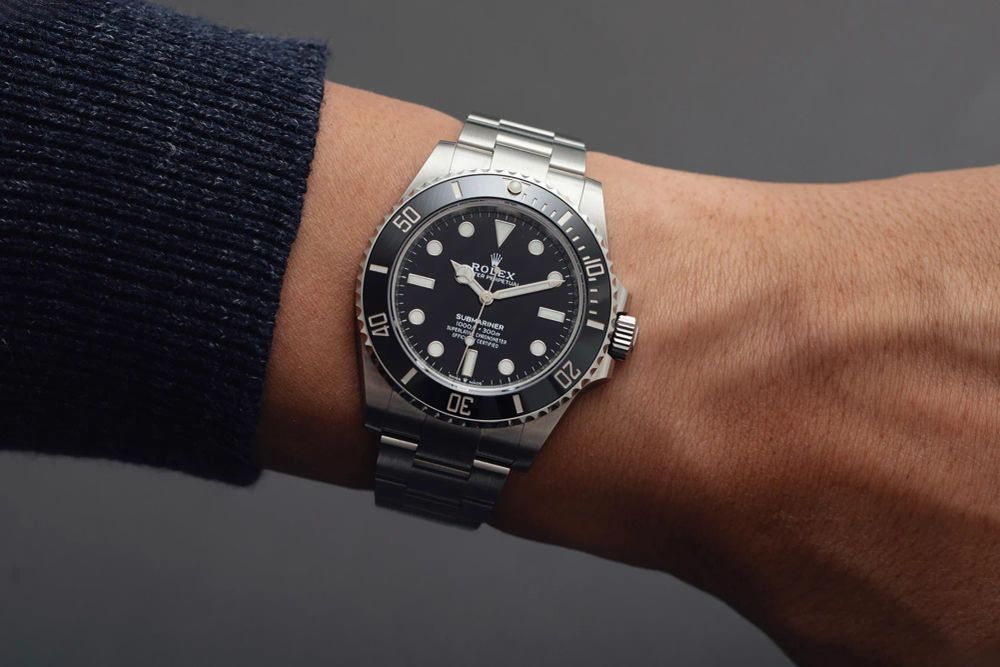
The reference 124060 — the current no-date model — is, by any objective measure, an exceptional watch. The movement, the 3230, is accurate, reliable, and finished to a standard that would embarrass most Swiss independents. The case proportions, at 41mm, are almost exactly right. The ceramic bezel insert is better than the aluminium it replaced. Every individual element represents the considered application of significant engineering resource.
And yet. There is something troubling about an object that has become so thoroughly mythologised that criticism of it reads as contrarianism. The Submariner is no longer reviewed — it is genuflected before. Watch journalists, acutely aware that Rolex's advertising budget flows elsewhere, have learned to describe rather than evaluate. The watch is what it is, they say, as if this were insight rather than abdication.
What it is, specifically, is a watch that costs CHF 9,550 at retail and trades at CHF 12,200 on the secondary market — a 28% premium that has nothing to do with horology and everything to do with artificial scarcity. The waiting list is not an accident of demand. It is policy.
None of this makes the Submariner a bad watch. It makes it a complicated object — one that has drifted so far from its original purpose that the 300 metres of water resistance printed on the dial has become almost purely decorative. The buyers are not divers. They are collectors, investors, and status-seekers wearing the visual vocabulary of utility without any of the intention.
Perhaps this is simply what happens to icons. They become representations of themselves. The Submariner is no longer a diving watch that became famous. It is fame that happens to be waterproof.
The question Rolex never has to answer, because the market never forces it to, is what comes next. What does a watch company do after it has made the perfect object? If the Submariner is so correct, why does the 2026 version need to exist at all?
The answer, of course, is that it doesn't. And Rolex knows this. The Submariner will still be here in 2056, marginally revised, impeccably finished, and trading at whatever premium the company decides the market will bear. It will be described as timeless. It will be.
But timeless and inspiring are not synonyms. The Submariner has earned its mythology. What it has not earned is immunity from the question of whether mythology is enough.