The Royal Oak is, at this point, a design so thoroughly absorbed into the visual vocabulary of watchmaking that it is easy to forget how radical it was. The year 1972 did not, by most measures, seem like a moment for bold gestures in Swiss watchmaking. The quartz crisis was visible on the horizon. The traditional houses were circling. The industry's instinct was toward consolidation and caution.
Into this environment, Gerald Genta delivered a sketch — executed, according to the legend, overnight on a single sheet of paper — that proposed an integrated bracelet, an octagonal bezel secured with visible hexagonal screws, and a "tapisserie" dial of such intricate guillochage that it would require its own dedicated tools to produce. The watch was to be made of steel, which was then a watchmaker's metal rather than a luxury one, and priced accordingly above — considerably above — the steel market's expectations.
The Royal Oak launched at CHF 3,300 in 1972, at a time when a Rolex Submariner retailed for approximately CHF 800. It was received with bafflement that gradually, over the following decade, resolved into admiration. Today the entry-level 15500ST — the direct descendant of Genta's original — retails at CHF 29,800 and trades on the secondary market at approximately the same figure, the premium having normalised in the two years since the peak of 2021.
Audemars Piguet has, in the intervening fifty-four years, extended the Royal Oak across every possible complication and configuration. The Offshore variant — launched in 1993 to considerable initial controversy — has become its own cultural artifact. The Royal Oak Concept line has explored material and mechanical extremes that Genta's original sketch could not have anticipated. The perpetual calendar, the chronograph, the skeleton — each has been executed with sufficient quality to justify its existence.
The question that haunts the Royal Oak, in 2026, is whether its ubiquity has begun to erode its distinctiveness. The design that was radical in 1972 has been imitated so thoroughly — by brands whose management consider the phrase "inspired by" adequate compensation for the act of copying — that the original now shares visual territory with a hundred lesser objects. The screws are everywhere. The integrated bracelet is everywhere. The tapisserie dial has been reproduced in every quality level from CHF 200 to CHF 200,000.
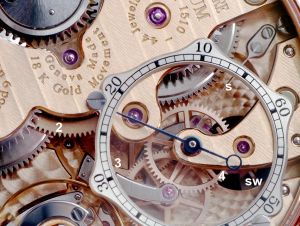
Audemars Piguet's answer to this erosion is the only correct one: to make the original better. The 15500ST's 4302 movement is, by any technical measure, an improvement on the 3120 it replaced. The hand finishing of the bridges, the quality of the regulation — these are details visible only to those who look closely. But they are the details that distinguish the Royal Oak from everything that quotes it without understanding it.