François-Paul Journe is not a modest man, which is one of the things that makes him trustworthy. Modesty in watchmakers is frequently performed — a rhetorical gesture toward the craft that obscures a commercial calculation. Journe does not perform modesty. He states his opinions directly, prices his watches accordingly, and has spent thirty years making objects that justify the confidence.
The Chronomètre Souverain is the watch with which Journe began. When it was introduced in 1999 — the same year as the Datograph, a coincidence of timing that has generated considerable debate about which is the more significant achievement — it contained two things that the Swiss establishment had largely abandoned as impractical: a remontoire d'égalité, or constant-force mechanism, and a movement in brass rather than the nickel silver that had become industry standard.
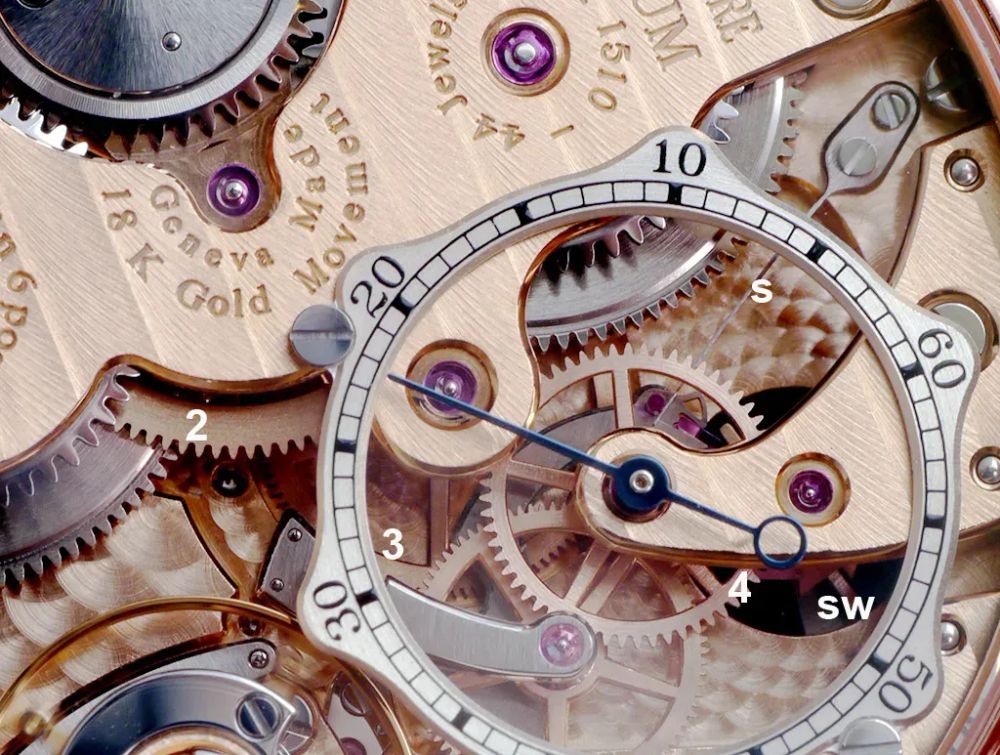
The remontoire is the watch's argument. Every four seconds, a small spring is rewound, delivering to the escapement a consistent force regardless of the mainspring's state of wind. The result is timekeeping accuracy that does not degrade as the power reserve depletes — a problem that most manufacturers address with clever regulation rather than mechanical solution. Journe's position, characteristically, is that the correct answer to an engineering problem is an engineering solution, not a workaround.
The brass movement is the watch's provocation. Brass is softer than nickel silver, more difficult to work to fine tolerances, and historically associated with lesser watchmaking. Journe uses it because, he argues, its acoustic properties are superior — the tick of a brass movement is different from that of nickel silver in ways that matter to him personally and, by extension, to the object. Whether this argument is technically correct or beautifully eccentric is a question the watch community has not resolved, which is itself a kind of answer.
The current Chronomètre Souverain is available in rose gold or platinum, with dial options that include silver, brass, and the limited annual series that Journe uses to mark particular moments. At CHF 110,000 in platinum — the secondary market price for a clean example — it is not, by the standards of its immediate competitors, overpriced. It is, however, priced at a level that requires genuine commitment.
That commitment is the point. Journe has never wanted the Chronomètre Souverain to be a casual purchase. He has wanted it to be a considered one — the watch chosen by someone who has looked at everything available at this price and concluded that accuracy delivered through mechanical ingenuity, in a case of 38mm that fits the wrist as a watch should fit a wrist, is the correct answer to the question of what a watch at this level ought to be.
He is, in this, correct. The Chronomètre Souverain is not the most technically complex watch you can buy for CHF 110,000. It is the most intellectually honest one.