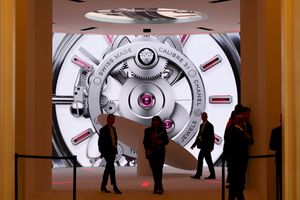
The Richemont pavilion at Watches & Wonders is approximately the size of a provincial airport terminal. It contains, at any given moment, several hundred people — brand representatives in coordinated attire, journalists with lanyards, collectors who have arranged access through channels that will not be described here — and produces a level of ambient noise consistent with an event rather than an experience.
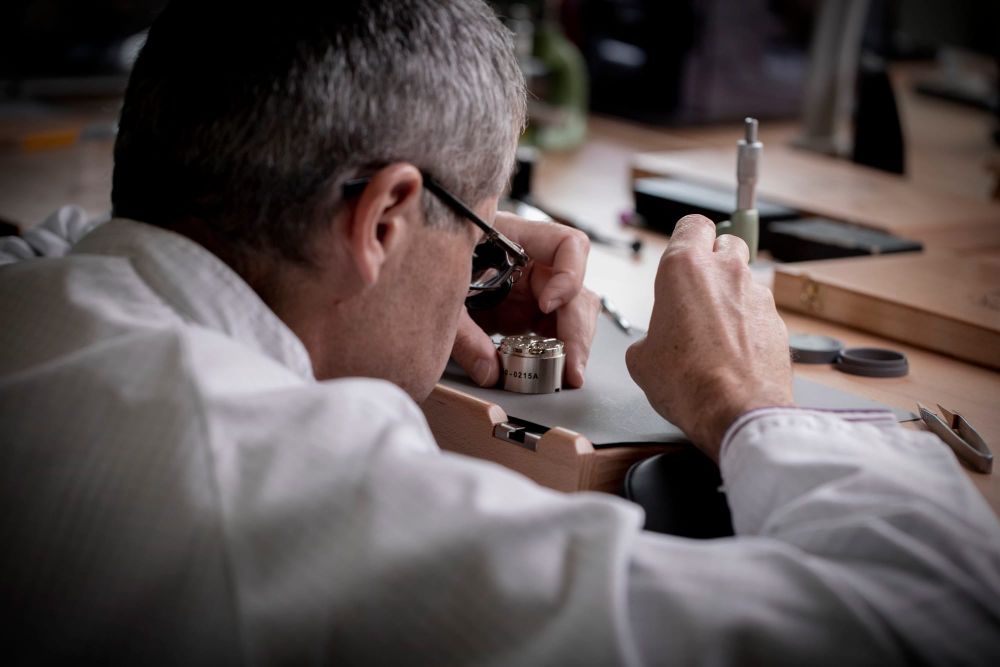
Forty metres away, separated by a corridor and a philosophical distance considerably greater, the independent pavilion contains eleven makers, perhaps sixty visitors at peak hours, and a quality of attention that the main hall cannot replicate. This is not accidental. The independents have arranged their presentations to reward exactly the kind of visitor who has decided, consciously, to spend less time at the Rolex table and more time looking at things that require looking at.
The standout presentation was Voutilainen, whose new Vingt-8 — a 28mm dress watch in white gold with a fumé dial in a colour somewhere between green and grey that resists easy description — attracted the most sustained attention of any object in the pavilion. Kari Voutilainen's movements are among the most finely finished in independent watchmaking, which is to say among the most finely finished in watchmaking without qualification. The Vingt-8 is the smallest watch he has produced and, in some ways, the most confident. Small watches require more from the maker and more from the wearer. Both have delivered.
MB&F's contribution was the kind of object that divides opinion cleanly: those who find Max Büsser's machine-age aesthetic precisely correct, and those who find it precisely incorrect. The new Legacy Machine 102 — a follow-up to the 101, extended with a second time zone — takes the floating balance wheel concept that made the LM a significant watch and adds the complication most useful to the kind of person who buys it. Travel. The movement, developed with movement specialist Agenhor, is mechanically orthodox in a way that MB&F's more theatrical pieces are not. This is, perhaps, the point.
H. Moser & Cie showed three new pieces, of which the most interesting was the least obvious: a Streamliner in a new alloy that the company has spent two years developing and declined to name, citing ongoing intellectual property proceedings. The colour — a blue-grey that shifts toward silver in direct light — is unlike anything currently in production. If the material is what the company implies it is, the watch represents a genuine contribution to the technical vocabulary of case construction. We will know more by autumn.
The argument the independent pavilion makes collectively is simple: that there are watchmakers, not companies, making decisions about every component based on conviction rather than cost structure, and that the resulting objects are different in kind from what the main hall offers — not necessarily better in every dimension, but different in the dimension that matters most, which is the dimension of intentionality.
Some of the visitors who spent an hour in the independent pavilion and then returned to the main hall reported finding it difficult to look at the larger brands' presentations with the same attention they had brought to them the previous day.
This is the independent pavilion's greatest achievement.